

Online casinos house edge explained
What is the house edge when gambling? It’s essentially the small (or extortionate in some cases) percentage the house, or in our case the online casino, takes so they are a profitable enterprise. Below we will explain what the house edge at online casinos is, why it’s important, how it is calculated and how you can refine your gameplay to minimise the house edge.
What is the house edge at online casinos?
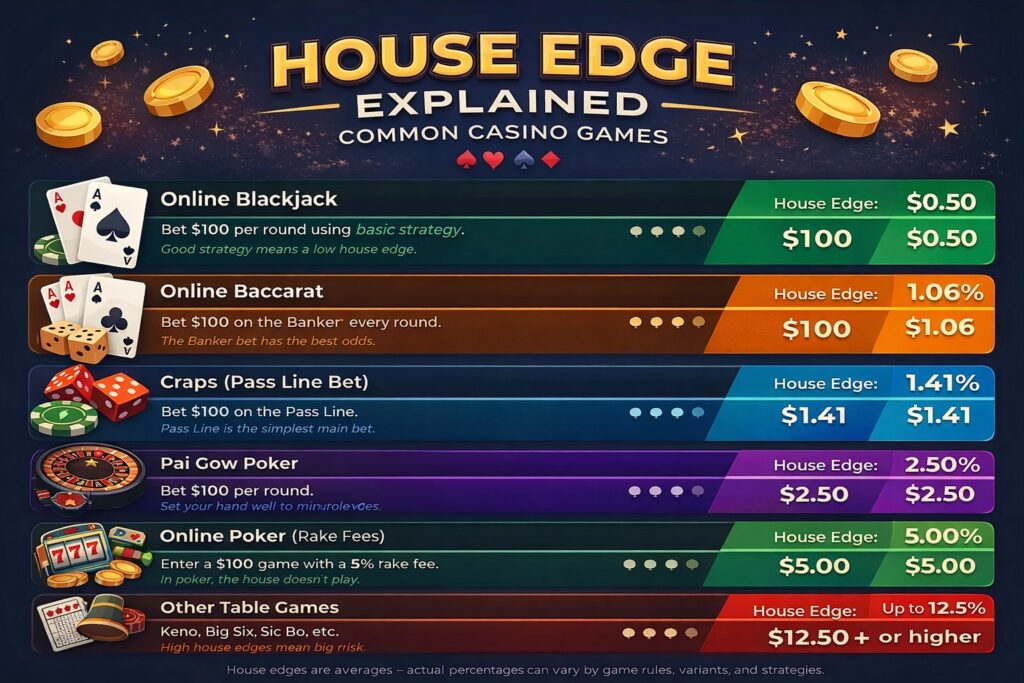
When it comes to gaming only one thing is always for sure: In a world of odds and probability the only thing you can count on is that the casino is going to make money. All games are structured in a manner that allows the house to hold an edge over every game.
This house edge will earn the casino profit over a long period of play, but the variance of that profit is wide enough for any player to have a chance of winning money. Experienced gamers know that not all games give up the same house edge, and that some games offer better odds to win than others.
Here’s a list of some of the basic games you’ll find in most casinos, both online and in live venues, and the average house edge each gives the casino.
In baccarat there are only two bets you can make; on the bank or on the player. A bet on the bank will give the house a 1.06% edge over you, while a bet on the player is better for the house with a 1.24% edge.
In the game of craps the best bets are the line bets and only carry an 0.8% edge with single odds. Double odds line bets are better for the player because the house is only getting a 0.6% edge over you.
Another game where the house has a small edge over you is in video poker. Deuces Wild games average a house edge around 4% and 1%. Jacks or Better games can have as little as 0.5% to 0.1% house edge, and progressive Video Poker (8/5 payoffs) can be between 2.2% and -2% (when the jackpot is big enough).
The difference between the two variants of roulette is worth mentioning. An American Roulette game has a house edge of 5.26%, while the European version only gives the house 2.7% over you.
The biggest edges in the casino are on the slot games and Keno. For both games the house edge can be as high as 25%. These games give the player the opportunity to win a big amount in one shot, but it can take a long time for it to happen.
Popular casino games house edge & examples
The house edge at online casinos does not factor in emotion, which is often the biggest driver of losses when gambling. Who hasn’t gone back to the cash point and got more money, just because you copped a bad break on the blackjack tables?
Lets take a look at some of the more popular casino games and give you an example of how the house edge works.
1. Online Baccarat
Scenario: You bet $100 on the Banker every round.
- House Edge: ~1.06%
- Expected Loss: $100 × 1.06% = $1.06
- Why: The Banker bet has the best odds due to commission adjustments, making it the safest main bet in Baccarat.
3. Online Roulette (European Wheel)
Scenario: You bet $100 on red every spin.
- House Edge: 2.70%
- Expected Loss: $100 × 2.7% = $2.70
- Why: European roulette has 37 numbers (1 zero), so even 50/50-style bets aren’t truly even odds.
5. Online Slots
Scenario: You wager $100 over multiple spins.
- House Edge: Typically 4%–10% (varies by slot)
- Expected Loss: $100 × 6% (avg) = $6.00
- Why: Slots have random outcomes and flashy bonuses, but often high house edges and volatility.
2. Online Blackjack
Scenario: You bet $100 per hand using basic strategy.
- House Edge: ~0.5% (can vary slightly based on rules)
- Expected Loss: $100 × 0.5% = $0.50
- Why: Blackjack has one of the lowest house edges if you play optimally. Deviating from strategy increases the edge.
4. Online Poker (vs. other players)
Scenario: You enter a $100 tournament or cash game.
- House Edge: 0% from game rules, but the platform takes a “rake”, often around 5–10%.
- Expected Loss: $100 × 5% = $5.00 (if rake is 5%)
- Why: In poker, the house doesn’t play — it just collects fees from pots or entries.
Minimising the house edge via strategy
The house edge is an inbuilt phenomena but there are some things you can do to improve your chances of winning, including game choice, engaging your smarts and using bonus offers and promotions to your advantage.
- Choose games with inherently low house edges, such as blackjack, baccarat (banker), or full-pay video poker, to reduce the casino’s built-in advantage.
- Learn and apply optimal strategy in skill-based games, especially blackjack and video poker, where correct decisions significantly lower expected losses.
- Select favourable rules and paytables, avoiding versions of games that worsen odds, such as 6:5 blackjack or low-return slot machines.
- Use casino bonuses and promotions carefully, as wagering with bonus value can temporarily offset or reduce the effective house edge.
- Avoid betting systems and side bets, which almost always carry a much higher house edge than the main game.
House Edge history & mathematical evolution
There isn’t a single person who explicitly “invented” the house edge, but the concept emerged from early probability theory in the 17th century.
The foundations were laid by mathematicians such as Blaise Pascal (who is largely credited with creating roulette) and Pierre de Fermat, whose correspondence in the 1650s formalised probability while analysing gambling problems. Shortly after, Christiaan Huygens introduced the idea of expected value, which is the mathematical core of the house edge.
Casinos later applied these ideas in practice by setting payouts slightly below true odds, ensuring a positive expected value for the house over time. So while the term “house edge” is modern, the concept traces back to early probability theory and the mathematics of expected loss and gain.
Commonly asked questions about the house edge
Do you have a question about the house edge at online casinos or retail gambling venues? Drop us a message in the box below or email us at contact@worldgamblinglist.com.
-
Does a lower house edge mean I’m more likely to win?
Yes, but it’s a long term proposition, with the house edge playing out over thousands of hands, rather than just your gambling session.
-
Is the house edge of games the same online and at retail casinos?
Often online casinos will have a lower house than comparable games at land-based casinos. This is because online casinos have much lower overheads, and can afford to give more back to the player.
-
Can skill or strategy reduce the house edge?
Yes, playing perfect strategy in blackjack for example, will keep the house edge at its minimum level. Other games, like online slots, are more luck-based, although playing max lines is often recommended to get the biggest payouts.
In short:
• skill can reduce the house edge in games where decisions matter
• skill cannot overcome the house edge in pure chance games
• no strategy guarantees profit, only better long-term value -
How does the house-edge impact short term results?
The house edge has little impact on short-term results, because luck and variance dominate over small samples of bets. Even games with a low house edge can produce quick losses, while high-edge games can still deliver short-term wins.
-
What casino game has the lowest house edge?
Blackjack when played with perfect strategy under favourable rules has a low house edge, with baccarat’s banker bet at 1.06% also good for the player. Variants of video poker like Jacks or Better can have close to zero house edge when played with perfect strategy.
-
Who sets the house edge at an online casino?
Generally the house edge is set by the game designer and casino. After games are created, they are audited and tested by independent auditors to check they are within the rules. As long as they tick the boxes they are allowed.