

Denmark moves to restrict gambling ads during live sport

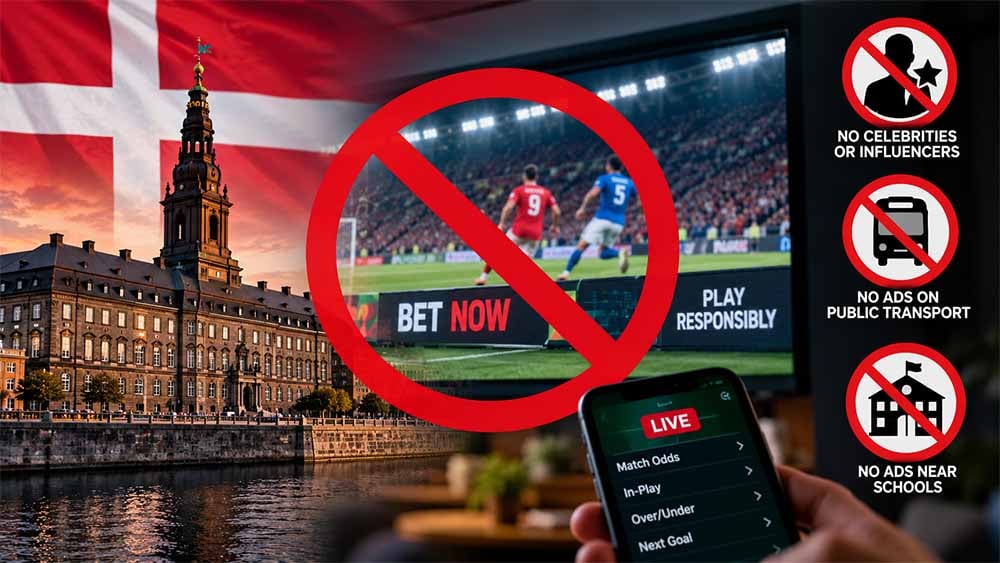
Denmark has reintroduced legislation that would ban gambling advertising during live sporting events, tighten restrictions on celebrity and influencer endorsements and impose tougher obligations on licensed gambling operators as part of a broader crackdown on gambling-related harm.
Minister for Taxation and Growth Jakob Engel-Schmidt presented Bill L 37 to parliament on October 7, reviving a package of reforms that had been delayed after an earlier legislative proposal lapsed following the country’s general election.
The legislation forms part of Denmark’s Gambling Package 1, a reform programme agreed by political parties in October 2025 that seeks to reduce gambling exposure among children and young people while strengthening oversight of the country’s regulated betting and online casino market.
Among its most significant measures is a prohibition on gambling advertising beginning 10 minutes before a live sporting event and continuing until 10 minutes after the broadcast ends, effectively removing betting promotions from television and streaming coverage throughout matches.
The restriction would also cover the display of live betting odds at sporting venues, preventing betting sites from using in-play prices as a promotional tool while events are taking place.
Denmark’s proposed advertising blackout would be accompanied by restrictions on gambling marketing in public spaces, including a ban on advertisements aboard public transport and in areas associated with public transport services.
Gambling advertisements would also be prohibited in public areas within 200 metres of schools and youth education institutions, with the distance measured from the outer boundary of the institution’s property rather than its main entrance.
The legislation goes further in regulating the content of gambling advertising, prohibiting advertisements featuring anyone under the age of 25 and restricting the use of authority figures whose status could influence consumers.
The proposed rules would also prevent operators from portraying gambling as a lifestyle, a social necessity or a means of achieving financial security, while requiring advertisements to present winning chances accurately and depict gambling primarily as entertainment.
These measures would place additional restrictions on the use of celebrities, sporting personalities and influencers in gambling campaigns, particularly where their public standing could encourage consumers to participate.
Affiliate marketing would also face significant changes, with the legislation prohibiting gambling operators from compensating third-party marketing partners according to the gambling turnover, winnings or losses of referred customers.
The restriction would directly affect revenue-sharing arrangements commonly used by online casino and sportsbook affiliates, although alternative payment structures, including fixed fees and payments for customer acquisition, would remain possible.
Importantly, the proposed advertising requirements would not be limited to licensed gambling operators themselves. The legislation would extend responsibility to third parties involved in marketing gambling products, creating additional compliance obligations for affiliates and advertising businesses operating in Denmark.
The bill also introduces a more explicit duty of care for licensed gambling companies, requiring operators to monitor customer behaviour and take immediate action when players display signs of problematic gambling or addiction.
Operators would be required to maintain written responsible gambling policies, train relevant employees and regularly assess whether interventions designed to protect at-risk customers are effective.
This would move the regulatory framework beyond simply requiring operators to identify potentially harmful gambling behaviour, placing a continuing obligation on companies to demonstrate that their responses are appropriate and effective.
Another important element of the legislation concerns Denmark’s efforts to combat illegal gambling, with the Danish Gambling Authority set to receive stronger enforcement powers against unauthorised operators and businesses promoting their services.
The proposed changes would explicitly prohibit the marketing of gambling products that are not licensed under Danish law, while extending restrictions to intermediaries and communication networks used to direct customers towards illegal gambling websites.
The legislation also seeks to strengthen the financial consequences of regulatory breaches by allowing authorities to consider a company’s turnover and any financial benefit obtained, or intended to be obtained, when determining penalties.
Under the proposed framework, the Danish Gambling Authority would also be able to resolve certain offences through administrative fine notices without requiring cases to proceed through the courts, provided the offending party accepts responsibility and agrees to pay.
Beyond online gambling and advertising, the bill includes changes to land-based gambling regulation, introducing a licensing framework for retailers selling gambling products and revising requirements governing gaming halls.
The proposals would require gaming halls to be staffed throughout their opening hours, prohibit entry to anyone under 18 and restrict the operation of gaming machines and certain simulated sports betting products to between 7am and midnight.
The reforms are intended to address concerns about gambling-related harm in Denmark, where authorities have previously estimated that approximately 25,000 children and young people experience some degree of gambling-related problems.
For licensed bookmakers and online casino operators, the legislation represents a substantial tightening of marketing and player protection requirements, while the proposed affiliate restrictions could force changes to existing commercial agreements with advertising partners.
If approved by parliament, the legislation would take effect in stages, beginning on January 1, 2027.
The principal advertising restrictions and enhanced responsible gambling obligations are scheduled to apply from July 1, 2027, giving licensed operators additional time to adjust their marketing practices and internal compliance procedures.
Changes affecting land-based gambling venues and retailer licensing would follow on October 1, 2027, although the Danish Gambling Authority would be permitted to begin processing certain licence applications from April.
Bill L 37 remains before parliament and has not yet been passed into law.
