

NSW to mandate facial recognition in pubs and clubs

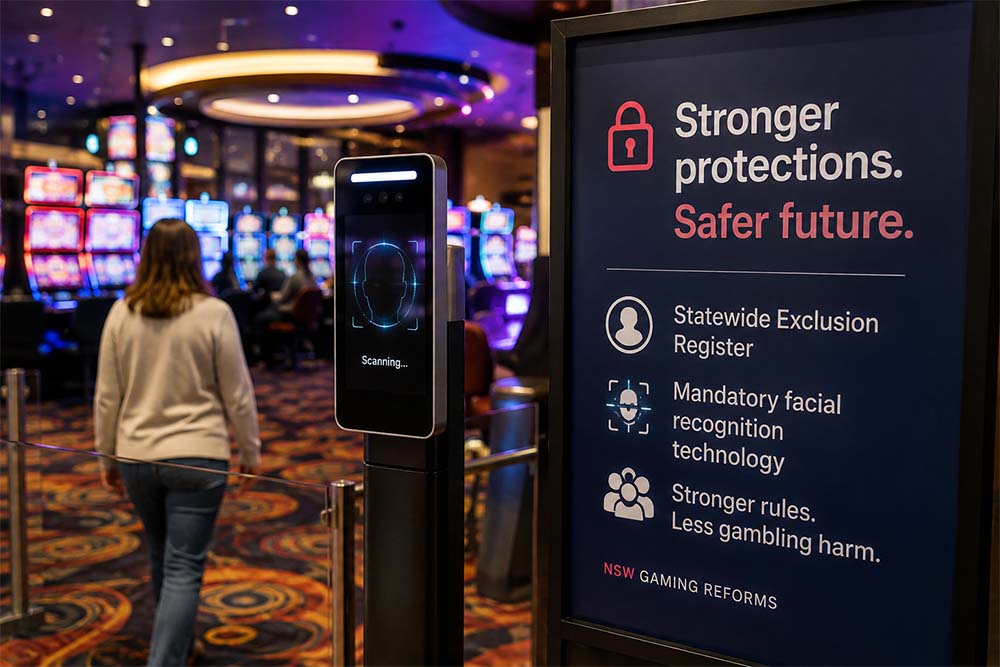
The New South Wales Government will introduce mandatory facial recognition technology across gaming rooms in pubs and clubs as part of a sweeping new package of gambling reforms aimed at strengthening self-exclusion and reducing gambling harm.
Under the reforms announced by the Minns Government, a new Statewide Exclusion Register will be introduced alongside mandatory facial recognition technology in 2028, allowing people to exclude themselves from gaming venues across NSW through a single system.
The technology will be used at gaming room entrances to identify people registered for exclusion, replacing the current fragmented system under which individual venues are largely responsible for recognising excluded patrons.
NSW Gaming and Racing Minister David Harris said the package represented a major expansion of the state’s harm-minimisation measures.
“By combining new technology, stronger exclusion tools, strengthened regulation and increased funding for harm reduction, we are building a safer system for the future,” Harris said.
“Our government will continually explore and implement emerging technology to ensure NSW has the most up-to-date safety measures available built into our gambling industry.”
The government had already introduced a voluntary code of practice for pubs and clubs using facial recognition technology in March, ahead of its planned mandatory rollout. The technology is intended to support rather than replace venue staff when identifying excluded gamblers.
The exclusion system will eventually be supplemented by a third-party exclusion scheme, allowing exclusions to be initiated by family and friends, venues and police in cases involving significant gambling harm or suspected criminal activity.
The package also targets the number of poker machines operating across NSW. The state currently has around 87,000 machines spread across approximately 2,100 clubs and hotels.
When gaming machine entitlements are traded, the forfeiture rate will increase from one in three to one in two, meaning one entitlement will be permanently removed for every two traded. A new “sinking cap” will ensure the statewide ceiling continues to fall as entitlements are surrendered.
The reforms also include a ban on VIP programs linked to gaming and gambling advertising across NSW Government and council-owned assets.
Betting operators will be prohibited from making unsolicited marketing calls or sending emails and text messages unless a person has expressly consented beforehand. New transparency requirements will also apply to promotions involving gambling affiliates and social media influencers.
The government will separately develop a NSW strategy targeting online gambling harm, including stronger enforcement against betting operators and illegal gambling platforms.
NSW will also upgrade its Centralised Monitoring System over the next two years to create the technical foundations for account-based poker machine play. Unlike a mandatory cashless system, the proposed infrastructure would allow venues to adopt account-based technology while players could continue using cash.
The government has committed $95.2 million over four years to the latest reforms, funded through remaining money in its $100 million gambling harm minimisation fund and increased gaming machine licence fees for hotels and clubs.
A further $20 million will be directed to the Responsible Gambling Fund over two years.
According to the government’s figures, the 2024 NSW Gambling Survey found 3.1% of adults experienced moderate-risk gambling and another 0.9% experienced high-risk gambling.
The latest package builds on measures already introduced by the Minns Government, including reducing cash input limits on new poker machines from $5,000 to $500, banning external gaming signage, introducing Responsible Gambling Officers at larger venues and revoking more than 650 exemptions that had allowed pubs and clubs to operate machines during standard shutdown hours.
Australia has moved in recent years to tighten laws surrounding poker machines, but is lagging when it comes to iGaming, with no licensed online casinos, although there is a proliferation of offshore sites targeting this part of the world.
